

Font size :
Color of the site :
Commission of the Republic of Azerbaijan on Combating Corruption
The Commission of the Republic of Azerbaijan, established on March 3, 2004, performs the functions of a body specialized in the prevention of corruption. The powers of the Commission are established by the Regulation approved by the law of the Republic of Azerbaijan dated May 3, 2005.
In its activities, the Commission is guided by the Constitution of the Republic of Azerbaijan, international agreements to which the Republic of Azerbaijan is a supporter, laws of the Republic of Azerbaijan, including other normative legal acts and this Regulation.
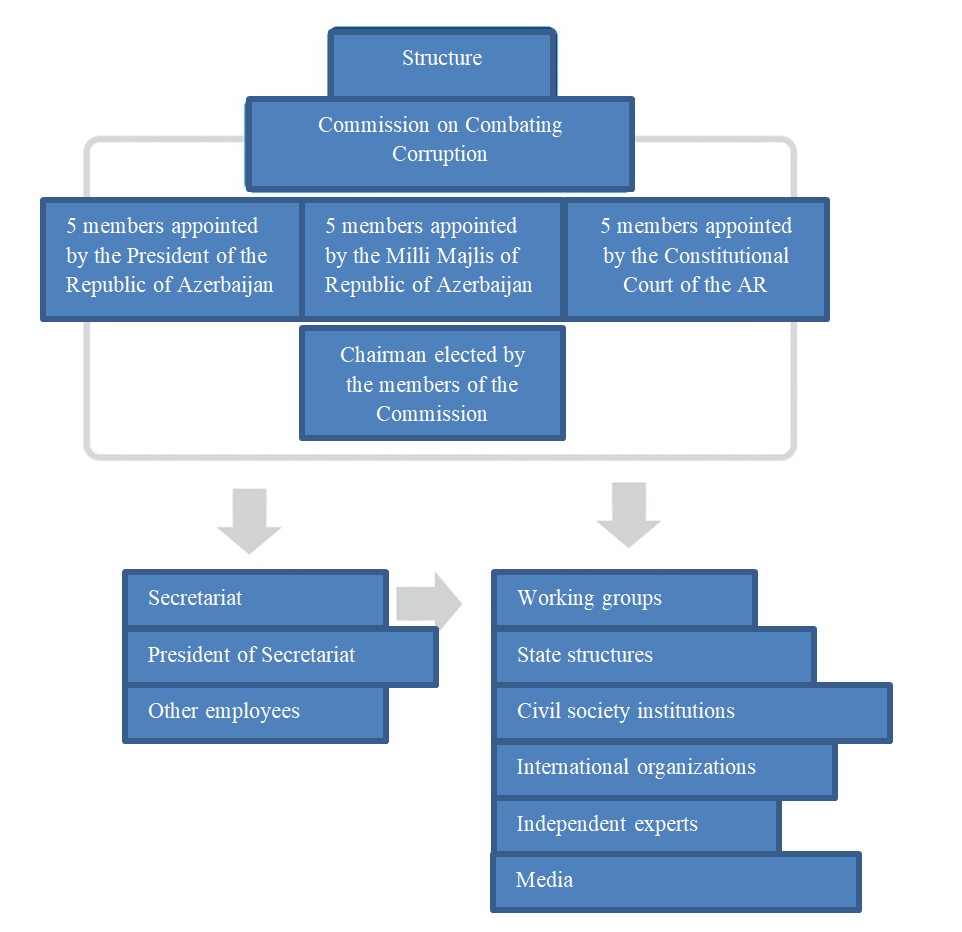
The Commission consists of 15 members, 5 of whom are appointed by the President of the Republic of Azerbaijan, 5 by the Milli Majlis and 5 by the Constitutional Court of the Republic of Azerbaijan.
The Commission establishes relations with the legislative, executive and judicial authorities, regularly informs the President of the Republic of Azerbaijan, the Milli Majlis and the Constitutional Court of the Republic of Azerbaijan on the state of the fight against corruption.
Management over the activities of the Commission and organization of its work is carried out by the Chairman of the Commission. A permanent secretariat is created under the Commission. The Secretariat deals with organizational matters for holding meetings of the Commission, prepares documents on issues that will be submitted to the Commission, performs clerical work, etc.
Issues assigned to the powers of the Commission are considered at its meetings. The meetings of the Commission are held on a regular basis, with the condition of at least once every three months.
Main responsibilities of the Commission
The Commission has the following main responsibilities:
• participate in the formation of the state anti-corruption policy, coordinate the activities of state bodies and other structures in this area;
• analyze the state and effectiveness of the fight against corruption;
• oversee the implementation of the State Anti-Corruption Programs;
• receive information of a financial nature;
• supervise the provision of financial information;
• collect, analyze, summarize information received in connection with corruption offenses, and submit proposals for consideration by state bodies;
• cooperate with government bodies and other structures in the field of combating corruption.
The Commission also performs other duties in accordance with the legislation.
Basic rights of the Commission
In order to fulfill its duties, the Commission exercises the following rights:
• studies the state of anti-corruption legislation and summarizes, hears reports from the heads of law enforcement agencies and other state bodies;
• receives the necessary information and materials from state bodies and bodies;
• receives information from the relevant state bodies on the implementation of measures provided for in state programs to combat corruption, and also analyzes the status of the work performed;
• prepares recommendations and proposals for increasing the effectiveness of the fight against corruption, as well as eliminating the deficiencies identified in the fight against corruption, takes measures to implement them;
• Carries out measures to study public opinion on corruption and conduct public awareness in the fight against corruption;
• cooperates with non-governmental organizations, mass media and representatives of the private sector, independent experts and, if necessary, involves them in the performance of certain works;
• participates in the implementation of international cooperation to organize and improve the effectiveness of the fight against corruption;
• summarizes appeals received in connection with corruption offenses, also instructs state bodies or audit organizations to check the activities of state or municipal bodies and state institutions in respect of which the largest number of complaints is received; upon detection of offenses containing signs of a crime, the test materials are sent to the General Prosecutor's Office of the Republic of Azerbaijan;
• if there are signs for verification, send these materials to the appropriate authorities;
• makes proposals for improving anti-corruption legislation.
• in connection with anti-corruption issues, provides financial support to non-governmental organizations for the preparation and implementation of programs and projects.
The Commission also exercises other rights in accordance with the law.

Xəbərlər gündəlik olaraq sizin e-poçt ünvanınıza göndəriləcək.
492-55-40 492-01-38
Concerning corruption and bribery

